microclimate
microclimate cooling system
what is cloud computing
what is asthma
what is information technology
what is equity
what is iso
what is autism
what is cyberbullying
microclimate cooling vest
what is a blog
what is cancer
what is poverty
what is aids
what is fair trade
what is bullying
what is climate change
what is a tsunami
what is dyslexia
what is happiness
microclimate geneva ny
what is energy
what is obesity
what is database
climatic zones of the earth
what is accounting
what is global warming
what is philosophy
what is marketing
what is networking
what is music
what is religion
what is research
what is economics
what is education
what is health
what is diversity
what is culture
what is democracy
microclimate ministat
what is law
what is stress
microclimate cooling
microclimates
what is technology
what is science
what is pollution
what is customer service
what is a hypothesis
what is geography
what is air
what is development
effect of microclimate
what is management
what is data
what is a computer
what is motivation
microclimate b1
microclimate thermostat
what is capitalism
what is computer
what is software
microclimate ministat 100
microclimate b2
what is internet
what is communication
what is chemistry
what is language
microclimate b1 thermostat
|
Microclimate in building
It is impossible to imagine comfortable and functional housing without particular conditions of air - temperature, humidity and serenity , which influence not only our physiological state and as a result our health, but also physical and hygienic state of building. There is no need in saying that people (especially children) who live a building with unfavorable humidity and temperature are more subject to illnesses; dirty air immediately makes a person feel unwell, causes sleep disorders and problems with metabolism.
Maintaining needed air temperature is, probably, most difficult thing while forming microclimate in building.
Optimal air temperature in various rooms of building differs from point of view of persons well-being, economic reasons and functions of building. Temperature in living room, study, dining room and nursery should be about 21-24 degrees; in bedroom, kitchen and toilet -20, bathroom - 24 degrees.
It is commonly considered that optimal average temperature for a building should be 20 degrees, and difference between temperatures in different rooms, to avoid discomfort while going from one room into other, should not be more than 3 degrees.
Chalk up
Air temperatures higher than norm make a person less stable to catarrhal diseases
Approximately such temperatures are used while projecting central heating systems in houses. Unfortunately, saying theory and practice differ describes real regime of work of heating devices in conditions of thermal isolation of a particular room in house or a flat. In most cases designers do not take into consideration needed difference in heating of different rooms, depending on their placement according to parts of world or wind directions during cold seasons. For calculations they use average scales of heat loses through doors and Windows of building and average temperature of coldest month. Definitely, they can not forecast personal sensitivity of people to temperatures while projecting impersonal housing.
|
Heat retention lagging of building
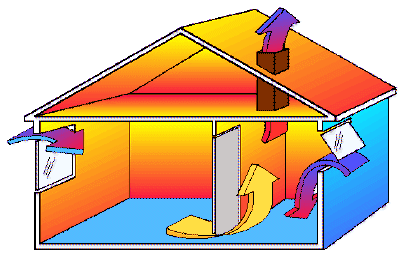
Not only heating devises influence air temperature in building during cold period of year. Heat retention lagging of building is also an important factor, in other words its protection from heat losses. Doors and Windows, also walls, floor and ceiling (roof) cause greatest heat losses. Particularly great heat losses are caused by frames of Windows of low quality and improper adjustment of glass. That is why you should pay special attention to Windows so that maintaining proper temperature in building does not take a lot of time, nerves and money. ways to winterize Windows are well-known: putting wool between frames of window and then sticking paper tape on it, putting special jointing material on clasps. first way, ancient one, is more practical but then window does not look esthetic; second is not so time-consuming but not always effective: jointing materials can cause defects of window frames, their locks, glue destroys paint and does not always sticks firmly jointing material. jointing materials themselves are not always stable enough to frost and humidity, that is why structure of material, necessary for proper sealing, is quickly ruined. This disadvantage is particularly common for rubber sealers, sometimes after only one cold and humid winter they fall to pieces.
Cannular sealers made of soft rubber have better characteristics, but they are less elastic and their clamp layer is bigger. They are more effective for sealing small window because they are more stable to temperature changes and mechanical loading. Sealers with glue layer on them are easy to fix on window frame, but they can disappoint during first opening of window when you see noodles on window. Very often dry glues used for glue layer are not durable enough, and after second sticking they are practically useless. So to be on safe side, it will make sense to use all-purpose adhesive before sticking sealer.
Recommendations for gluing sealer.
Clear surface of dust and dirt beforehand, places where you will glue sealer rub with cleaner.
Wet surface should be left to dry. layer of glue on window frames and sealer (if it does not have a glue layer of itself) should be thin.
Do not press frame to sash when you have just put sealer on glued surface, sealer can stick in wrong way and glue will fix its position. What is more, extra amount of glue will gather on roughness of frame, thus it can soak sealer made of thin rubber and stick it to work surface.
Do not use nails to fix sealer to frame. holes made with nails in sealer will let in air, and they do not disappear, as some may think, after pressing frame to sash.
Heat losses and coming cold air are caused not only by joints in frames, but also by cracks formed because glass does not fit frame properly. Sealers will not help in this situation, special window lute is needed here (stopper).
But it is also subject to influence of temperature and humidity, especially in out joints. simplest lute is chalk mixed with stand oil. It is not stable to cold and humidity; it can shrink because of high temperatures, that is why it should be painted after cracks are sealed. Lutes and stoppers on glue base are more long-lasting and solid, but do not always have needed color and are difficult to handle because they fasten quickly. What is more their expansion coefficient is bigger than one for whiting putty, that is why low temperatures can cause crackles between lute layer and window, and destroying water gets into them.
Handy tips
If you want lute to stay longer, you should apply it, if possible, when temperature is rather low outside (early spring or late autumn) and, what is more important, on dry frames.
|
How to deal with heat losses in house. Multiple glazing.
There is a more radical way to deal with heat losses through window frames - putting in so called multiple glazing. Multiple glazing consists of frames with two (or more) inbuilt glasses, which are connected with a shoulder along perimeter. space between glasses is filled with dry air, which prevents glass from weeping and formation of condensate. Vacuum multiple glazing is a more modern way of preventing heat losses. There is no air between glasses at all and that does not let heat exchange between outside and inside glasses. It should be mentioned though that multiple glazing like usual Windows has joints on sash, which may need additional sealing.
Effectiveness of Windowsealing also depends on adjusted of latches and bolts on window frame. They should close with noticeable but not abnormal effort, because if frame is pressed to sash too hard it can cause obliquity and early wear of sealer.
|
Heat losses in house through entrance door.
Entrance door is another black hole which lets out heat and therefore lets in cold. Good sealing of doors, especially those facing staircase landing and in first floor flats, will insure not only smaller heat losses and also absence of draft. standard method of sealing and winterizing of doors with special materials is usually not effective as it has many defects from beginning. Putting moulds and fixing them with nails on door will not give needed result simply because it does not press door to door-case completely. If you decide to cover door with insulant, then you should do it from side to which it opens: inside for flats and outside for houses. thing is that leaf must not have defects at joints with door-case, and it is difficult to achieve while putting material on door-case. So one should mix up meaning of winterizing and sealing of door, though many try to combine these things.
No matter whether door is winterized or not it is necessary to take measures and seal joints between door and door-case. process is similar to sealing of window frames; only difference is that sealer is put on case, and it should fit size and match color of door. last point is not obligatory as sealer can be seen only when door is open.
Work of latches and catches should be taken into consideration when choosing thickness of sealer. latches and catches of door must press it closely to door-case and at same time there should not be any scratching on chases in door-case, and door itself must not move if latches are locked.
|
Temperature regime in building. Heat conductivity of materials.
The temperature in room is also influenced by material of walls, floor and ceiling (roof), and by material and its quality of outside and inside joinery.
It is well-known that thermal conductivity of wood is lower than of breaks and of cause of concrete. But a wooden house has a big disadvantage - it has more joints than houses made of breaks or concrete, and these joints need proper and time-consuming sealing. It should be mentioned that building materials can change depending on humidity of air. Thus it will make sense to check joints of floor and ceiling with walls, of walls with Windows, so that no drafts appear. You can do it with help of a lit up match or a narrow strip of paper.
There are less joints in houses made of breaks and concrete, and it is a lot easier to fix them with cement; but there is another problem in such houses - faster, than in wooden houses, cooling of outside walls and ceilings in winter and warming in summer.
We are able to forecast these negative effects while choosing material for joinery of walls, floors and ceilings. warmest floor covering is that made of wool, half woolen or synthetic carpeting. warmest covers of walls are wooden panels, and expanded plastic can be used for ceiling and its winterizing. A painted wall is colder than walls with wallpapers. Flat wallpaper is colder than textured ones, compact and thick wallpaper is warmer than thin and loose, wallpaper from natural paper is better than from synthetic. A carpet on wall will make room warmer and whitewash will make room colder. If there are equal conditions of heat exchange and rooms are equal in size, one with less furniture will be colder, but it will quickly get warmer because air circulation is more intensive.
Small window, which opens towards wall close to window, will make room cold quicker because cold air intensively circulates along wall. These and other factors, which may seem unimportant in comparison with heating or cooling of air itself or heat-insulation, can influence temperature in room if combined.
|
|
|